Pregnancy apps without a subscription: what to look for
Pregnancy lasts nine months, but most big pregnancy apps want a monthly subscription that quietly outlives it. Here is what those subscriptions actually cost over a pregnancy, why nearly every large app charges that way, and how to tell a genuine one-time purchase from a "free trial" that is really a recurring plan.

The short version
- A $4.99/month plan costs roughly $45 across a pregnancy; a $9.99/month plan costs about $90.
- Annual plans cost the same for nine months of use as for twelve, and renew after the birth unless you cancel.
- The pricing model tells you who the customer is: with ads, advertisers pay; with a purchase, you do.
- One-time purchases exist, but they are rare — look for the words "one-time" or "lifetime" in the app's in-app purchase list.
The subscription math over nine months
Individually, app subscriptions look small. Stacked against a pregnancy they are not. Here is what the common price points in this category add up to, from a positive test to the birth — roughly nine months of use — and over a full year, since annual plans keep charging after the baby arrives.
| Typical plan | Cost over 9 months | Cost over 12 months | Still charging after the birth? |
|---|---|---|---|
| $4.99 / month | ≈ $45 | ≈ $60 | Yes, until you cancel |
| $9.99 / month | ≈ $90 | ≈ $120 | Yes, until you cancel |
| $49.99 / year | $49.99 | $49.99 | Renews on the anniversary |
| $79.99 / year | $79.99 | $79.99 | Renews on the anniversary |
| One-time purchase (Lunera PRO) | $9.99 | $9.99 | No — there is nothing to renew |
These are the common price tiers in the category rather than a quote for any particular app; premium prices change often and vary by country, so check the App Store listing before you buy. Lunera's $9.99 is its actual current one-time price.
The annual plans are the ones worth reading twice. A $79.99 yearly plan bought at week 6 covers your pregnancy comfortably — and then renews about three months after the birth, at a point when you have almost certainly stopped opening a pregnancy app. That renewal is not a trick; it is simply what an annual subscription does. It is just a poor fit for an event with a hard end date.
Why nearly every big pregnancy app charges monthly
It is worth understanding the incentive rather than assuming bad faith, because it explains what the money buys.
Large pregnancy apps are not really trackers. They are publishing operations: daily articles, video courses, expert Q&As, moderated community forums, sometimes clinical partnerships. That is genuine ongoing cost — editors, moderators, video production, servers — and ongoing cost is exactly what a subscription is designed to fund. If you want a daily feed of new content and an active forum full of people due the same month as you, a subscription is the honest way to pay for it.
The problem is that the pricing model has spread to apps doing none of that. A pure tracker — weeks, baby size, countdown, a contraction timer — has no meaningful recurring cost per user. Charging monthly for it is a pricing decision, not cost recovery.
I can be specific here because I built one. Lunera has no server: your data lives on your iPhone, so there is no per-user hosting cost, no database to scale, and no bandwidth bill that grows with downloads. The real costs are Apple's $99/year developer program, the time to write and maintain the app, and translating it into nine languages. Those are costs of existing, not costs of you using it — which is why a one-time purchase works for this kind of app and would not work for a magazine.
The four pricing models you will meet
Almost every pregnancy app in the App Store fits one of four shapes. Recognising which one you are looking at tells you more than any feature list.
| Model | Who pays | What you give up | Where you see it |
|---|---|---|---|
| Free, ad-supported | Advertisers | Attention, and usually data used for ad targeting | The big content-and-community apps |
| Freemium + subscription | Advertisers and you | Core features held behind a recurring paywall | Most large trackers with a "Premium" tier |
| Subscription only | You, monthly or yearly | No usable free tier; a trial that auto-renews | Newer health and cycle apps |
| Free + one-time purchase | You, once | No daily editorial feed, no large forum | Small independent apps, including Lunera |
Individual apps move between these models and premium prices differ by region, so this compares models rather than naming prices for specific competitors. The model is far more stable than the price — and it is visible for free: open any App Store listing and read its In-App Purchases section before downloading.
How to check before you commit
Five minutes on the App Store listing answers most of it.
- Read the In-App Purchases list on the listing page. Apple shows every purchase an app offers, with its price. An item named "Premium — Monthly" is a subscription. "Lifetime", "Forever", or "One-time unlock" is a purchase. If the list contains only monthly and yearly items, there is no non-subscription path, whatever the marketing copy says.
- Treat "free trial" as "subscription". On the App Store a free trial is a property of an auto-renewing subscription. It converts to a paid renewal automatically unless you cancel at least 24 hours before it ends. That is the standard mechanic rather than a dark pattern — but it means "try it free" and "no commitment" are not the same sentence.
- Check whether the free tier is usable on its own. The honest test: can you see your current week, your baby's size and your due date countdown without hitting a paywall? If the single most basic function is gated, the free tier is an advertisement, not a product.
- Look for ads in the screenshots and reviews. Ad-supported pregnancy apps monetise your attention, and an ad SDK usually implies data collection for targeting. The private pregnancy tracker guide covers what that means for pregnancy data specifically.
- Ask whether the price fits the timespan. You need this app for about 40 weeks. Any recurring charge has to be actively stopped afterwards, and that admin lands on you in the least convenient month of your life.
- Check whether a second pregnancy costs again. With a subscription it certainly does. With a one-time purchase it should not.
How to cancel a subscription you already have
If you are reading this because something is already renewing, it takes about thirty seconds on an iPhone: open Settings, tap your name at the top, then Subscriptions. Every auto-renewing subscription bought through the App Store is listed there — including ones bought inside apps you have since deleted, because deleting an app never cancels its subscription. Cancelling stops the next charge, and you keep access until the end of the period you already paid for.
Worth doing now rather than after the birth: set a calendar reminder a few days before the renewal date shown on that screen.
What a one-time purchase honestly cannot give you
Balance matters here, and I would rather you chose the right app than my app.
A one-time purchase cannot fund a newsroom. An independent app will not give you a daily article feed written by a staff of editors, a video course library, or a busy forum of people due the same week as you. If those are what you actually want, a subscription app is the right choice and the money is buying something real.
What a one-time purchase funds well is a tool: something that answers your four recurring questions instantly, sits on your lock screen, works offline, and does not need a monthly business relationship with you. Most people, once the novelty of the content feed wears off somewhere in the second trimester, find that a tool is what they were opening the app for anyway.
Lunera: free tracker, $9.99 once for PRO — never a subscription
Lunera's week-by-week tracking, baby size comparisons, due date countdown, contraction timer, widgets, and notifications are free, with zero ads. The optional Lunera PRO upgrade is a one-time $9.99 purchase — less than the cheapest monthly plans cost across a pregnancy — and unlocks:
- Week Explorer: browse all 40 weeks, including the ones ahead of you
- 5-1-1 pattern detection during labor, plus a guided breathing exercise
- On-device AI insights with Apple Intelligence, PDF contraction reports, and iCloud sync
Buy it once and it is yours forever — including for your next pregnancy, on every device signed in to the same Apple account.
What free actually covers in Lunera
Since "free" is the most abused word in this category, here is the exact line, so you can hold the app to it:
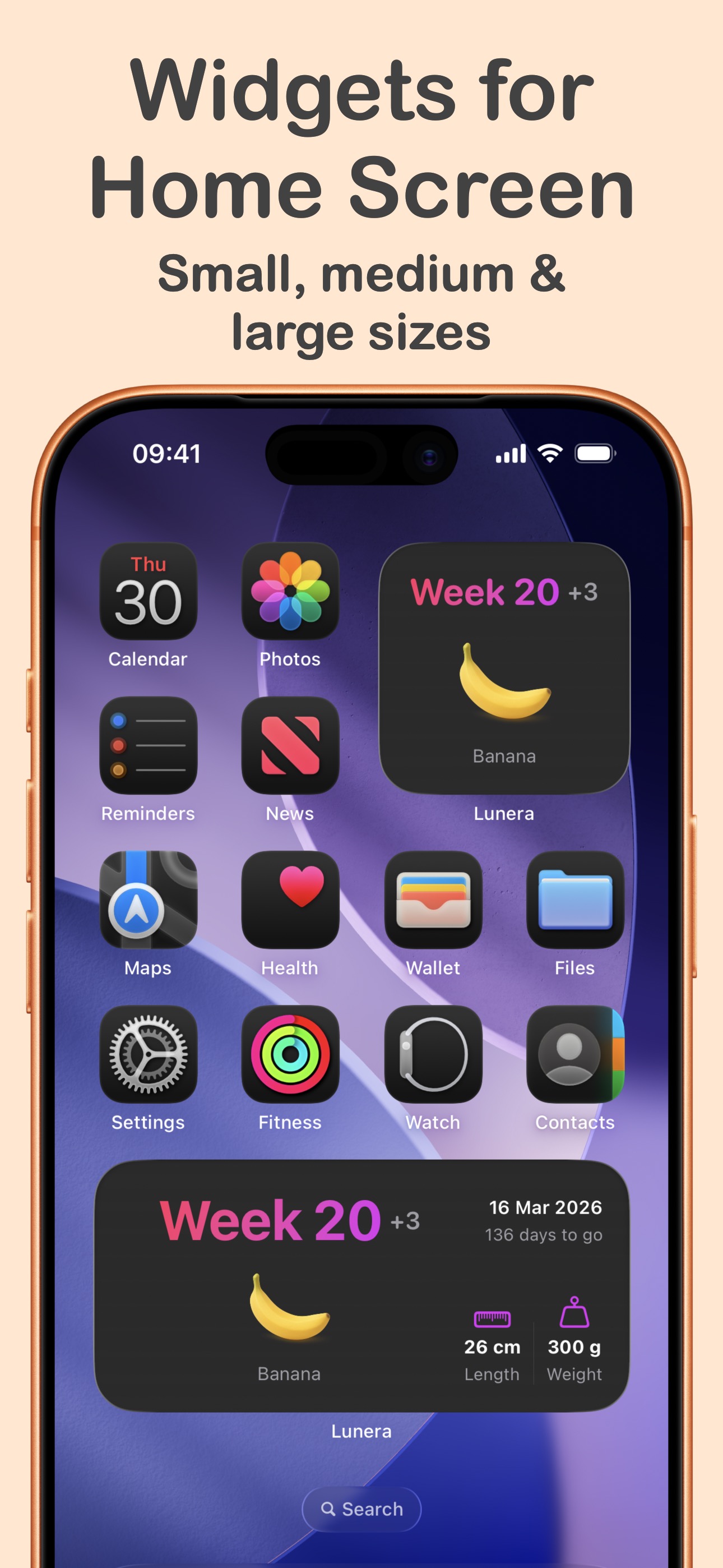
- Free, no account, no ads: your current week and day, due date countdown, trimester progress, this week's baby size comparison, weekly notifications, home screen and lock screen widgets, the contraction timer with full history, and Siri.
- PRO, $9.99 once: Week Explorer, 5-1-1 detection, guided breathing, on-device AI insights, PDF export, and iCloud sync.
If you never buy PRO, nothing degrades, no ads appear, and nothing you have already entered is taken away. You can time an entire labor on the free tier — the contraction timer is not the paywalled part.
Quick answers
Is there a pregnancy app without a subscription?
Yes, though they are a minority. Look for an app that is free to download with a single one-time in-app purchase rather than monthly or yearly items. Lunera works this way: a free tracker with no ads, and an optional $9.99 one-time PRO upgrade.
How much do pregnancy app subscriptions cost over a whole pregnancy?
At $4.99 per month you pay about $45 across nine months; at $9.99 per month, about $90. Annual plans of $49.99–$79.99 cost the same for nine months of use as for twelve, and renew after the birth unless you cancel.
Is Lunera really free?
Yes — downloading and using the core tracker (weeks, sizes, countdown, contraction timer, widgets, notifications) is free with no ads. PRO is an optional $9.99 one-time purchase, not a subscription.
Will I be charged again for a second pregnancy?
No. Lunera PRO is a one-time purchase tied to your Apple account. Start a new pregnancy in settings anytime — everything you unlocked stays unlocked, on every device signed in to the same Apple account.
How do I cancel a pregnancy app subscription on iPhone?
Open Settings, tap your name at the top, then Subscriptions. Every App Store subscription is listed there, including ones from apps you have deleted. Cancelling stops the next renewal, and you keep access until the period you paid for ends.
Does a free pregnancy app mean my data is the product?
Often, but not always. Free plus advertising usually means an ad SDK is present, and pregnancy status is valuable targeting data. Free plus a paid upgrade and no ads means the app is funded by the people who buy the upgrade — which is why pricing and privacy tend to travel together.
Track your pregnancy with Lunera
Week-by-week baby development, due date countdown, widgets, and a one-tap contraction timer — free, private, and subscription-free on iPhone.
This guide is for informational and educational purposes only and is not medical advice. Lunera is not a medical device. Always consult your doctor, midwife, or healthcare provider with any questions about your pregnancy or labor.